


Japan: The Cleaning Ritual of Todaiji's Great Buddha in Nara

Japan’s Daibutsu statues, or Great Buddhas, embody centuries of Buddhist faith and artistry. These colossal statues serve as timeless symbols of enlightenment and reverence. The "Ominugui Ceremony" at Todaiji Temple in Nara is a sacred tradition where participants meticulously dust and wipe the statue, symbolizing purification and devotion.

© O. Robert
Japan is home to some of the most awe-inspiring representations of Buddha in the world, known as Daibutsu, or "Great Buddhas". These majestic monuments, often crafted from bronze, wood, or stone, sometimes covered with gold, embody the spiritual and artistic devotion of the eras in which they were created.
Dating primarily from the 8th to the 13th centuries, the Daibutsu statues were commissioned by emperors, monks, and wealthy patrons to inspire peace, faith, protect the nation, and honor the teachings of Buddhism.

© O. Robert
The Daibutsu are most commonly depicted in 2 positions: seated or reclining. The seated posture, often in the lotus position, symbolizes meditation and enlightenment, while the reclining posture represents Buddha’s final moments before entering Nirvana. Hand gestures, or mudras, are equally significant. The Dhyana Mudra, where the hands rest in the lap with palms facing upward, signifies meditation. The Bhumisparsha Mudra, with the right hand touching the earth, recalls the moment of Buddha’s enlightenment. These gestures, combined with the serene expressions of the statues, invite contemplation and reverence.
Sizes of the statues vary dramatically, with some statues standing over 10 meters tall (like the Todaiji Great Buddha), while others, like the reclining Buddha of Nanzo-in, stretch over 41 meters in length. The materials used in their construction reflect the technological and artistic advancements of their time. Each Daibutsu is not only a work of art but a spiritual beacon, drawing pilgrims and visitors into a dialogue with the divine.

© O. Robert
The Temple of Todaiji in Nara
Todaiji Temple, located in Nara City, is one of Japan’s most significant and historically rich Buddhist sites. Founded in 752 by Bishop Roben under the reign of Emperor Shomu, it was established as the head temple of all provincial Buddhist temples in Japan. The temple’s construction was a monumental effort, driven by the emperor’s desire to unify the nation through Buddhism and peace.
Todaiji and its Great Buddha statue are also a UNESCO World Heritage Site and a cornerstone of the Nara Period (710-794), a time when Buddhism flourished as the state religion. It is said that about 2 millions people were involved in its construction.

Todaiji belongs to the Kegon school of Buddhism (736), which emphasizes the "interconnectedness of all phenomena". Kegon is one of the 3 Nara Buddhism schools, along with Hosso (710) and Ritsu (795) schools. Each school has a "Honzan temple", which is a representative and administrative center of the school. Todaiji is the Honzan temple of Kegon.
The temple complex originally housed 2 pagodas, a lecture hall, and a refectory. Though many structures have been rebuilt over the centuries due to fires and natural disasters, the 2 pagodas were never rebuilt.
The Great Buddha Hall (Daibutsuden) is one of the largest wooden building in the world. Its dimensions are impressive, measuring 57 meters by 50 meters with a height of 48 meters. This size is 33% smaller than the original hall before it was burned down in 1180 and a second time in 1567. Even if it was rebuilt several times, it remains the heart of Todaiji and a testament to the ingenuity of ancient Japanese architecture.

© O. Robert
The Great Buddha of Todaiji
The Daibutsu of Todaiji is a bronze statue of Vairocana Buddha (Dainichi Nyorai in Japanese), the cosmic Buddha who embodies the essence of enlightenment. The statue stands at 14.98 meters tall, with a face measuring 5.33 meters in length, eyes 1.02 meters wide, and ears 2.54 meters long. Daibutsu's shoulders span 28 meters across, and it weighs about 500 tonnes. The height of the lotus petal where the statue stands is 3.05 meters.
The Daibutsu is made entirely of bronze and was originally covered in gold (see below). The statue’s head was restored after a fire in 1692, which is why its color appears slightly different from the body, giving it a newer look compared to the rest of the statue.

Join us for a Photo Tour where you’ll discover timeless beauty, immerse yourself in local culture, and uncover hidden photographic gems. We explore Japan’s contrasts, tradition and modernity, serenity and energy, nature and urban pulse… If these dualities inspire you, see the programme here.
The statue was originally cast in 8 separate pieces between 743 and 751, with the head and neck cast together as a single element. The current hands of the statue were made during the Momoyama Period (1568-1615), and the head was recast in the Edo Period (1615-1867).
The Daibutsu sits in the lotus position, with its right hand forming the Abhaya Mudra (a gesture of reassurance and protection) and its left hand in the Dhyana Mudra (a gesture of meditation). The statue’s serene expression and grand scale invite contemplation and reverence, embodying the spiritual and artistic devotion of the era in which it was created.

© O. Robert
Materials Used in its Original Construction
The primary material used in the construction of Todaiji’s Great Buddha statue is bronze, which is a metal alloy consisting mostly of copper and tin. When it was originally completed in the 8th century, the entire exterior of the bronze statue was covered in a brilliant layer of gold.
According to historical temple records, the massive casting original project required an immense amount of raw materials:
Copper: Approximately 437 tonnes
Tin: Approximately 8 tonnes
Gold (for gilding): Approximately 440 kilograms
Mercury: Used in a toxic gold-mercury amalgam process (Kake-guri) to paste and heat-fuse the gold leaf onto the bronze surface.

© O. Robert
Reconstruction and Mixed Materials Today
Because the statue was heavily damaged and partially melted by fires during civil wars over the centuries (most notably in 1180 and 1567), the statue you see today is a composite of different historical eras:
The Lotus Petals & Base: Mostly original 8th-century Nara Period bronze.
The Torso & Waist: Re-cast during the Kamakura Period.
The Hands: Re-cast during the Momoyama Period.
The Head & Neck: Re-cast during the Edo Period.
As a result of these fires and centuries of incense smoke, the original bright gold plating was lost on the main body, leaving the statue with its iconic, deep charcoal-black bronze appearance today.

The Ominugui: A Ritual of Purification and Devotion
The Ominugui, or "Great Buddha Cleaning Ceremony", is one of Todaiji’s most cherished traditions. Held annually on August 7th, this event draws hundreds of participants who gather to clean the Daibutsu in a symbolic act of purification and merit-making.
The ceremony begins at 7:30 AM with a Buddhist service led by the temple’s monks. Participants, dressed in white robes, are divided into groups and assigned specific sections of the statue to clean. Using long-handled brushes and cloths, they gently dust the surface of the Daibutsu, starting from the top and working their way down. The process is meticulous, with each group focusing on areas such as the face, hands, or robes of the statue.

© O. Robert
Who Can Attend and Clean
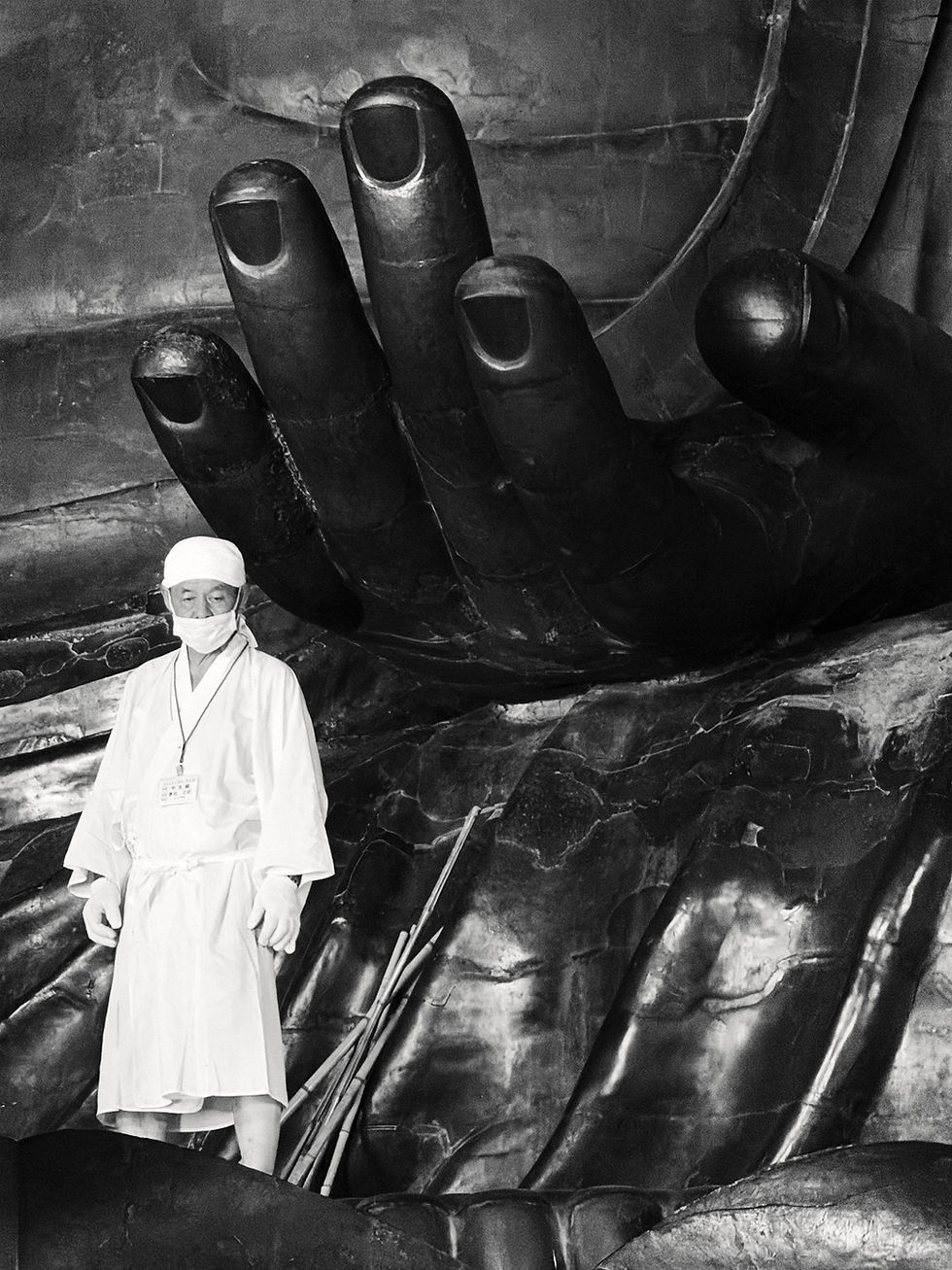
The Cleaners: Only monks, priests, temple staff, and registered temple followers (volunteers) are permitted to physically touch and clean the statue. Between 120 and 170 authorized individuals participate each year.
General Public and Tourists: The general public cannot participate in the physical cleaning. However, anyone can attend as a spectator. The Great Buddha Hall (Daibutsuden) opens its doors to visitors at 7:30 AM, allowing travelers to witness the rare sight of the mid-cleaning process. This is an exceptional event that attracts a large crowd, including the national press. From experience, I strongly advise arriving by 6:00 AM to guarantee a good position, both in the queue and in the ceremony hall.

© O. Robert
How the Ceremony is Organized
The event follows a strict, time-tested spiritual and physical process:
Dawn Purification: At dawn, the participants gather at the temple bathhouse (the Yuya near Nigatsu-do Hall) to bathe and spiritually purify themselves. They dress entirely in sacred white robes and straw sandals.
Removing the Soul (7:00 AM): Before a single speck of dust is touched, the Abbot of Todaiji Temple leads a solemn Buddhist service to chant sutras. This ritual temporarily removes the "spirit" or "soul" of the Buddha. This step ensures the sacred entity is not defiled when workers physically climb on its shoulders, head, or arms.

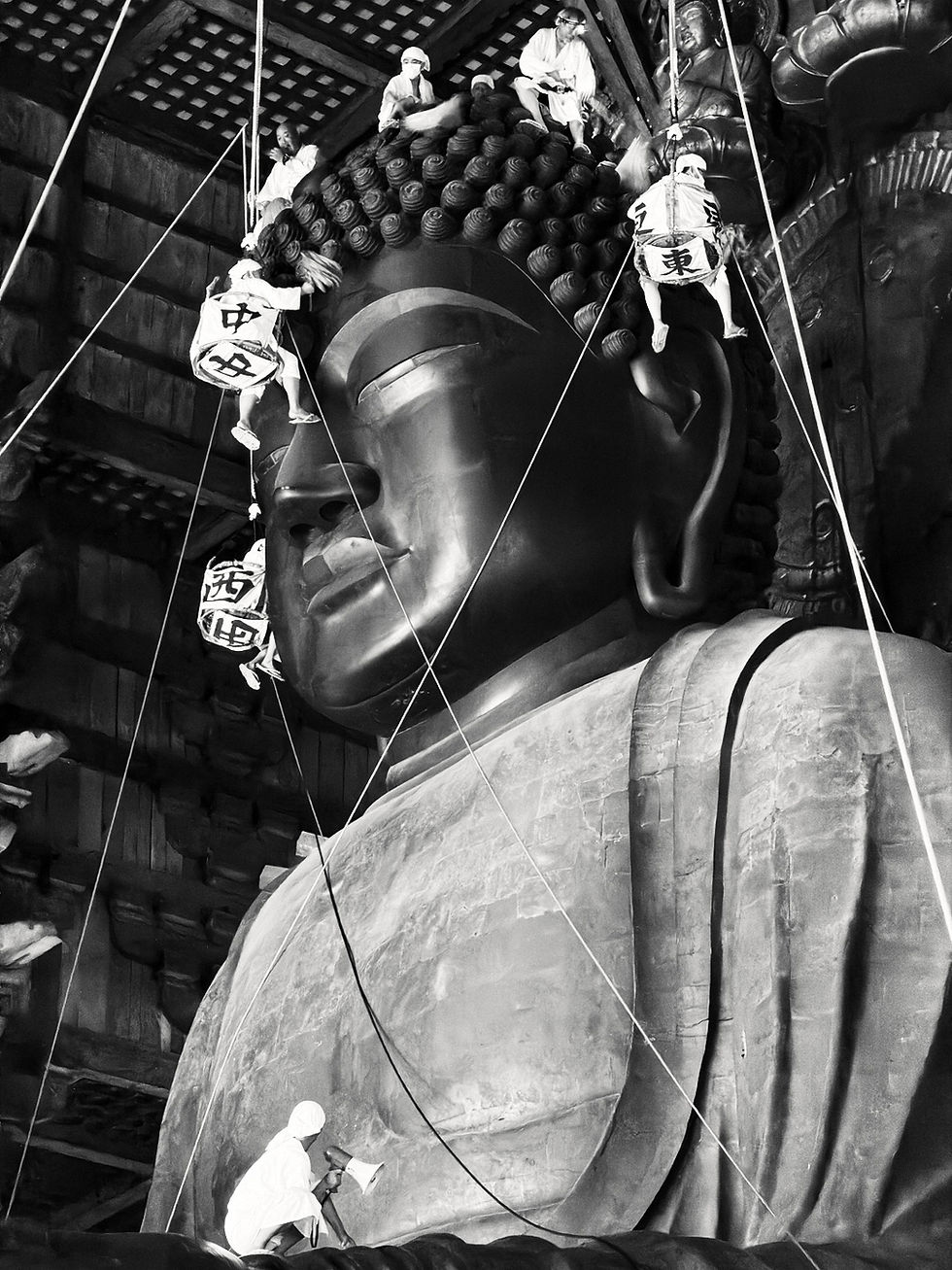
The High-Altitude Cleaning: Workers are placed in 3 manually hoisted gondolas (baskets) suspended from the ceiling rafters to wipe down the head, face, and chest. The gondolas are named according to the cardinal points of east (東) and west (西) (not left (左) and right (右)), as well as the center (中), as can be seen in some of the photos above and below.
Other participants use ropes to scale the statue's lower body, meticulously wiping down the bronze curls, hands, and knees with specialized dusters, cloths, and bamboo brooms.
Completion (Around 9:00 AM): The entire cleaning takes about 2 hours. Once the statue's deep black luster is restored, the soul of the Buddha is ritually invited back into the icon.
The cleaning is not only a physical act but a spiritual one. As participants cleanse the statue, they also purify their own hearts, reflecting on their actions and intentions. The ritual culminates in a collective prayer for peace and prosperity. The Ominugui is a rare opportunity for laypeople to engage directly with the sacred, fostering a sense of community and shared devotion.
© O. Robert
Other Similar Cleaning Ceremonies in Japan
Multiple Great Buddha statues across Japan undergo similar annual cleaning rituals, though the execution varies depending on whether the statue is indoors or outdoors. The 2 most famous examples that share this tradition are the Takaoka Daibutsu and the Ushiku Daibutsu.
1. Takaoka Daibutsu (Toyama Prefecture)
The Takaoka Great Buddha follows a ritual that is nearly identical to Todaiji's.
The Ritual: Held annually on September 23rd during the Takaoka Daibutsu Matsuri, monks and temple staff dress in sacred, all-white robes to wipe away a year's worth of dust.
Public Access: Unlike Todaiji, where the public can only watch, the Takaoka festival actively welcomes the general public to climb up onto the statue's platform after the official cleaning is over to pray right in front of the Buddha's lap.
© O. Robert
2. Ushiku Daibutsu (Ibaraki Prefecture)
As one of the tallest bronze statues in the world (120 meters), the Ushiku Daibutsu requires a much more extreme version of the ritual.
The Ritual: Held around the autumn equinox, this event is traditionally referred to as "soot removal".
The Execution: Because of its staggering height, the cleaning cannot be done by a large group of monks. Instead, a dedicated team of professional high-altitude workers scales the outside of the statue using ropes, harnesses, and high-pressure water sprays to clear bird droppings and dust from the giant face, eyes, and ears.

My equipment: K&F CONCEPT ND FILTER KIT + magnetic ring and carrying bag. Rainproof treated glasses. A practical solution for photographing in difficult conditions without compromising on quality. Check it out here.
The Exception of Outdoor Statues
Outdoor monuments, like the Kamakura Great Buddha or the towering 120-meter Ushiku Daibutsu mentioned above, face constant degradation from acid rain, industrial pollution, earthquakes, and salty ocean air.
Because it sits entirely outdoors, it undergoes highly technical, deep-cleaning and structural conservation projects managed by cultural heritage scientists every few decades rather than a yearly spiritual dusting like the Todaiji Ominugui.

The Main Daibutsu Statues of Japan
Japan is home to numerous Daibutsu statues, each with its own history and significance. Below is a list of the most notable ones. This list is, of course, not exhaustive and only features the main Daibutsu statues that I've had the pleasure of photographing or visiting.
The information provided about these statues is based on my own research. The sources sometimes mention differing dates and characteristics.
Todaiji, Nara (this article):
Vairocana Buddha
14.98 meters tall, 500 tonnes, bronze
Seated, 752
Kōtoku-in (Kamakura Daibutsu), Kamakura, Kanagawa:
Amida Buddha
13.35 meters tall, 93 tonnes, bronze
Seated, 1252
Nanzo-in Reclining Buddha, Sasaguri, Fukuoka (photo below):
Nehanzo Buddha
41 meters long, bronze
Symbolizes Buddha’s entry into Nirvana
Reclining, 1995

© O. Robert
Ushiku Daibutsu, Ushiku, Ibaraki:
Amida Buddha
120 meters tall (including base and lotus), 4.000 tonnes, bronze, modern engineering
Standing, 1993
Nihon-ji Daibutsu, Kyonan, Chiba:
Yakushi Nyorai
31.05 meters tall, stone-carved, largest pre-modern Daibutsu
Seated, 1790 (restored 1969)
Gifu Daibutsu, Gifu (photo below):
Shaka Nyorai
13.63 meters tall, wood, lacquered
Seated, 1832

Tsubosaka-dera, Takatori, Nara:
Shaka Nyorai
10 meters tall, stone
Seated, 2007
Great Buddha of Shuurakuen, Tokai (Nagoya), Aichi:
Amida Nyorai
18.79 meters tall, reinforced concrete (Japan’s first reinforced-concrete Daibutsu)
Seated, 1927
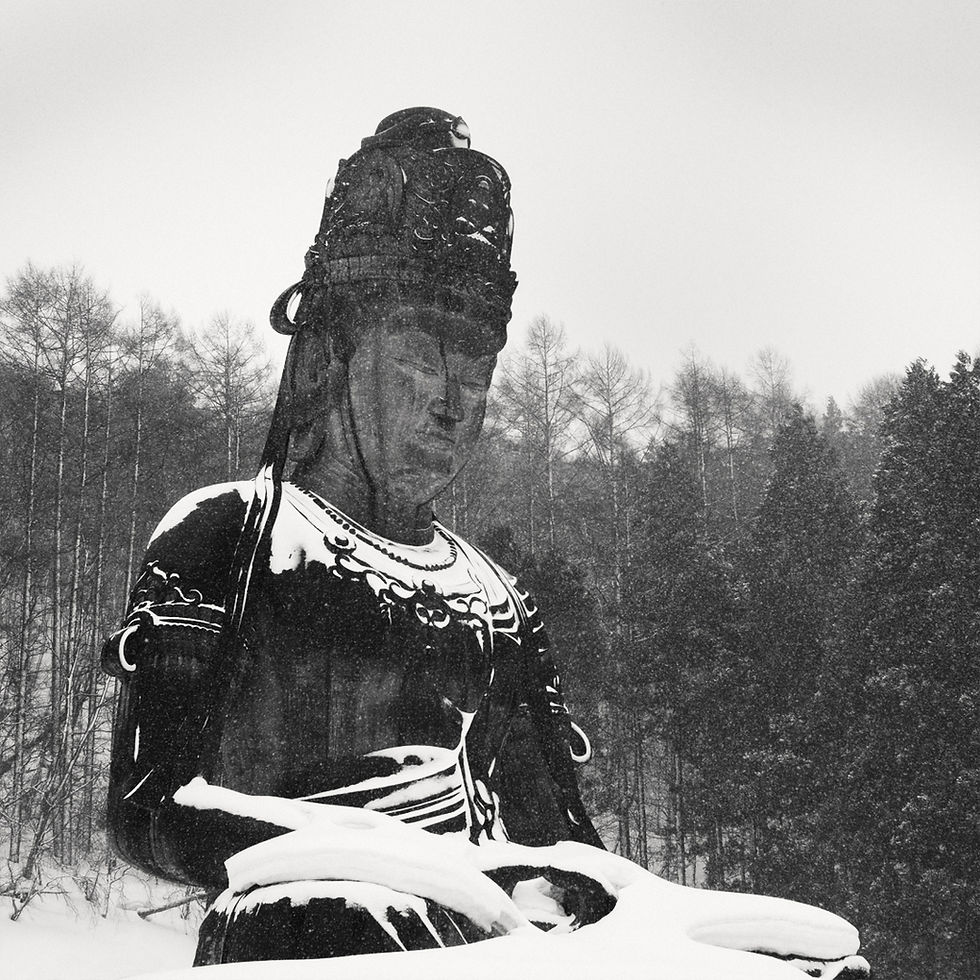
Shōwa Daibutsu, Aomori, Aomori (photo below):
Vairocana Buddha
21.35 meters tall, bronze
Seated, 1984
Asuka-dera, Asuka Daibutsu, Asuka, Nara:
Shaka Nyorai
2.75 meters tall, bronze
Seated, 609
Daishizan Seidaiji, Echizen Daibutsu, Katsuyama, Fukui:
Shaka Nyorai
17 meters tall, material unknown
Seated, date unknown
Daibutsuji, Takaoka Daibutsu, Takaoka, Toyama (photo below):
Amida Buddha
15.85 meters tall (including base and lotus), bronze
Seated, 1933

Jorenji, Tokyo Daibutsu, Itabashi, Tokyo:
Shaka Nyorai
13 meters tall, 30 tonnes, bronze
Seated, 1977
Toganji, Green Daibutsu, Nagoya, Aichi (photo below):
Shaka Nyorai
10 meters tall, bronze, painted in green with gold leaf on the eyelids, lips, and ears
Pedestal of 5 meters tall, supported by 10 elephants statues (no lotus)
Specific hand gesture of Ashoka Chakra
Seated, 1987 (repainted in 2006)

© O. Robert
Kamagaya Daibutsu, Kamagaya, Chiba:
Shaka Nyorai
2.3 meters tall (including base), bronze, Japan’s smallest Daibutsu
Seated, 1776
Koshoji Temple, Yagoto, Nagoya, Aichi (photo below):
Amida Nyorai
17.1 meters tall, 6 tonnes, Lacquered bronze (notable for its red color)
Seated, 2014
Movable statue, regularly relocated within the temple's grounds for different purposes

Join us for a Photo Tour where you’ll discover timeless beauty, immerse yourself in local culture, and uncover hidden photographic gems. We explore Japan’s contrasts, tradition and modernity, serenity and energy, nature and urban pulse… If these dualities inspire you, see the programme here.
The Final Word
The Daibutsu statues of Japan are embodies of faith, artistry, and the enduring human quest for meaning. Standing before a Daibutsu, one is struck not only by its sheer scale but by the quiet power it exudes.
For photographers, the Daibutsu offers a unique challenge: how to capture not just the physical details but the spiritual essence of these monuments. The play of light on bronze, the symmetry of the lotus position, and the expressions of serenity invite us to look beyond the surface. In photographing the Daibutsu, we are not just documenting an object, we are engaging in a dialogue with history and culture.
As you explore these statues through the lens, take a moment to reflect on the centuries of devotion they represent. Relics of the past, Daibutsu statues are also living symbols of a tradition that continues to inspire and uplift.
And if you are lucky enough to be in Nara on August 7th, don't hesitate to head to Todaiji to capture this impressive Ominugui ceremony on camera!


