


Lake Geneva: Belle Epoque, the Historic Paddle Steamers Fleet

The paddle steamers of Lake Geneva, also known as the "Belle Epoque" fleet, are a collection of historic steam-powered vessels operated by the "Compagnie Générale de Navigation". These ships primarily date back to the early 20th century and are a unique feature of Lake Geneva, offering scenic cruises between Swiss and French shores.

© O. Robert
They are a powerful source of photographic inspiration due to their sleek lines, their presence on the lake, and their legendary history. The design of these steamers is characterized by large side-mounted paddle wheels, elegant period interiors, and vintage steam engines, making them iconic symbols of the region’s maritime heritage.
What is the Belle Epoque
The Belle Epoque, which translates to "Beautiful Era", refers to a period in French and European history from approximately 1871 to 1914. It is mainly characterized by:
Cultural Flourishing
Technological and Social Progress
Economic Growth
Elegance and Luxury
Political Stability
The Belle Epoque is often remembered for its optimism, cultural vibrancy, and the significant social changes that occurred during this time.

© O. Robert
The Steamers of Lake Geneva
Currently, there are 5 steam-engine paddle steamers and 3 paddle steamers restored with a diesel-electric engine on Lake Geneva:
Steam engine:
Montreux (built in 1904)
La Suisse (built in 1910)
Savoie (built in 1914)
Simplon (built in 1915-1920)
Rhône (built in 1927)
Diesel-electric engine:
Vevey (built in 1907)
Italie (built in 1908)
Helvétie (built in 1926)
These vessels have been preserved and restored over the years to maintain their historical charm, and some have been fitted with modern hybrid steam-electric engines to ensure smoother operation while retaining their original paddle-wheel propulsion.

Most of these ships were built by Swiss or European shipyards, with riveted steel hulls and wooden, luxurious interiors designed in the Belle Epoque style (Art Nouveau influence). These paddle steamers were designed for passenger transport, sightseeing cruises, and mail delivery across Lake Geneva, serving both the Swiss and French shores.
These ships are kept in pristine condition through periodic renovations, ensuring they remain operational while preserving their vintage charm and technological significance from the early 20th century.

© O. Robert
The Compagnie Générale de Navigation (CGN)
The Compagnie Générale de Navigation (CGN) was established in 1824. It was created to manage and operate steamship services on Lake Geneva, marking the beginning of a long tradition of passenger and cargo transport on one of Europe's most picturesque lakes.
The CGN fleet is one of the last of its kind, operating these historically significant vessels on regular routes and special cruises. They remain a symbol of Swiss maritime and industrial heritage on Lake Geneva.

CGN operates a well-rounded fleet that includes:
Historical Paddle Steamers
Motor Vessels for general and event services
Electric and Solar-Powered Vessels for eco-friendly operations
High-Speed Catamarans for fast commuter services

© O. Robert
Active Paddle Steamers
Hereunder is the detailed list of the paddle steamers, operated by the Compagnie Générale de Navigation (CGN) with key information.
SS and MS Prefixes
The prefix "SS" before the names of the paddle steamers stands for "Steam Ship". Obviously, this designation is used to indicate that the vessel is powered by steam, specifically a steam engine.
In the context of the paddle steamers on Lake Geneva, the SS designation reflects their original steam-powered propulsion, which was a common mode of power for ships built in the late 19th and early 20th centuries.

The prefixes "MV" and "MS" are both commonly used to designate motorized vessels, but they have subtle differences based on maritime convention:
MV (Motor Vessel): This prefix is widely used for vessels powered by any type of motor, most commonly diesel engines. It's especially common for larger ships.
MS (Motor Ship): This prefix is also used for motorized ships, and it’s more popular in some countries and regions in Europe. However, it is often applies to passenger ships or ferries, but it has the same basic meaning as MV, denoting a motor-powered vessel. It is the standard prefix used by the CGN for its diesel-powered vessels.

© O. Robert
Below is the list and some details of the current ships in the CGN fleet. I have categorized them by year of entry into service, from the oldest to the most recent. The order therefore does not reflect historical significance nor the size of the ships.
I. Steam Engine
1. SS Montreux (1904)
One of the most famous and the oldest in the fleet, the Montreux was restored in the late 1990s. Even though it is the oldest boat in the Belle Epoque fleet, it is equipped with the most recent steam engine. It primarily serves routes between Geneva, Lausanne, and Montreux. Its first-class lounge is unique in that its magnificent woodwork comes from another steamer, the SS Valais, which was decommissioned in 2003.
Length: 68 meters (223 ft)
Width: 14.3 meters (47 ft) with paddles
Passenger capacity: 560
Engine type: Originally steam, converted to hybrid steam-electric in 2001
Power: 750 horsepower (560 kW)
Maximum speed: 27 km/h (14.5 knots)
Restoration: Extensive restoration from 1998 to 2001

2. SS La Suisse (1910)
The flagship of the fleet, fully restored. It is often considered the most beautiful steamship in the world.
A large and majestic paddle steamer, known for its ornate Belle Epoque design.
It runs mostly between Lausanne and Chillon Castle (Read my article dedicated to Chillon Castle here).
Length: 78.5 meters (257 ft)
Width: 15.9 meters (52 ft) with paddles
Passenger capacity: 850
Engine type: Compound steam engine
Power: 1,400 horsepower (1,044 kW)
Maximum speed: 28 km/h (15 knots)
Restoration: Refurbished in 2009 to restore its original Belle Époque splendor
© O. Robert
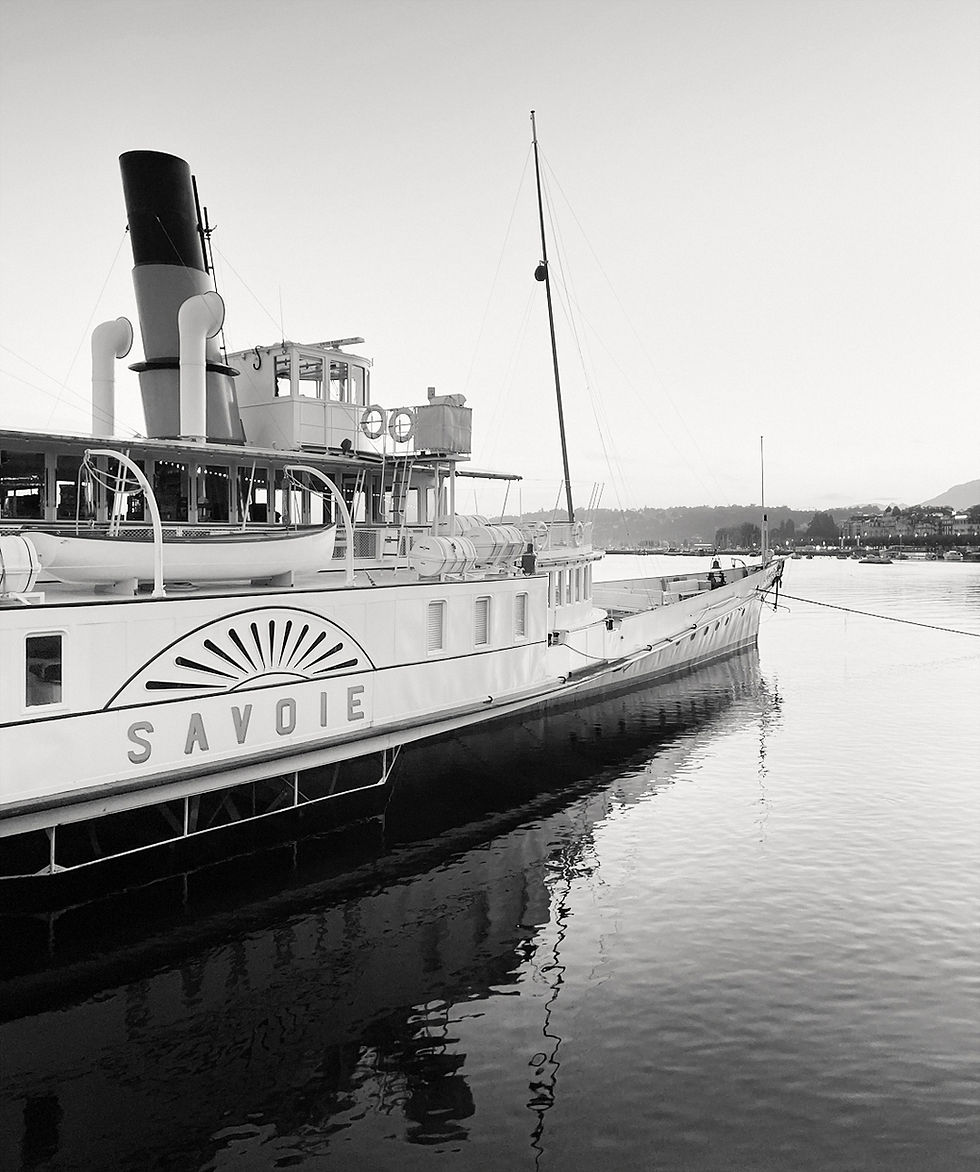
3. SS Savoie (1914)
The design of this ship was heavily inspired by the SS La Suisse, although it is of medium size, resembling the SS Rhône or the SS Montreux. The Savoie serves shorter routes and is often seen between Geneva and Yvoire (France).
Length: 63 meters (206 ft)
Width: 14.2 meters (46.5 ft) with paddles
Passenger capacity: 560
Engine type: Compound steam engine
Power: 750 horsepower (560 kW)
Maximum speed: 25 km/h (13.5 knots)
Restoration: Entirely refurbished in 2006

4. SS Simplon (1920)
Of the same dimensions as the flagship SS La Suisse, this large steamer impresses with the power of its engine. It is the first steamer where the boiler is located at the rear and the engine at the front, which alters the boat’s silhouette due to the position of its smokestack. After two partial renovations in 2005 and 2011, this ship will still require one last major renovation before 2030. The SS Simplon is also known for its unique art deco interior.
Length: 78.5 meters (257 ft)
Width: 15.9 meters (52 ft) with paddles
Passenger capacity: 850
Engine type: Compound steam engine
Power: 1,400 horsepower (1,044 kW)
Maximum speed: 28 km/h (15 knots)
Restoration: Major restoration in 2005 and 2011 (next one schedule for 2030)

© O. Robert
5. SS Rhône (1927)
The youngest ship of the fleet, the SS Rhône is the last steamer entirely built in Switzerland. This vessel is equipped with a one-of-a-kind steam engine with automatic pressure lubrication, requiring the crankshaft to be covered by casings. Originally metal, these casings were replaced in 2011 with plexiglass models, allowing passengers to admire the rhythmic movements of the engine. It is also famous for its spacious decks and panoramic views. The SS Rhône typically operates between Lausanne and Geneva.
Length: 68.3 meters (224 ft)
Width: 14.3 meters (47 ft) with paddles
Passenger capacity: 650
Engine type: Originally steam, converted to hybrid steam-electric
Power: 1,000 horsepower (745 kW)
Maximum speed: 27 km/h (14.5 knots)
Restoration: Last restoration from 2019 to 2022

II. Diesel-Electric Engine
1. MS Vevey (1907)
This steamer was restored with a diesel-electric engine and is often considered alongside the steamers due to its historical significance and paddle-wheel propulsion. One can admire its very beautiful light first-class lounge with inlaid chestnut wood and enhanced with sculpted bronze fittings. The MS Vevey typically operates between Lausanne and Geneva.
Length: 66 meters (216.5 feet)
Width: 14 meters (45.9 feet), including paddle wheels
Passenger Capacity: Approximately 560 passengers
Engine Type: Diesel-electric engine
Power: 600 horsepower (HP)
Maximum Speed: 27 km/h (14.6 knots or about 16.8 mph)
Restoration: Major restoration in 2013

© O. Robert
2. MS Italie (1908)
Previously named MS Lausanne. This diesel-electric steamer was renovated in 2016 to be identical to its twin, the MS Vevey and is considered by many as legendary. Indeed, for nearly 50 years, the MS Italie operated the trans-Lake Geneva route from Le Bouveret to Geneva and back from April to October, marking the daily rhythm of local life by whistling as it approached the docks. Nowadays, the MS Italie operates alongside the Riviera of Lake Geneva, which is renowned for its natural beauty, cultural richness, and the high quality of life it offers to residents and visitors alike.
Length: 63 meters (207 feet)
Width: 13.8 meters (45 feet), including paddle wheels
Passenger Capacity: Approximately 560 passengers
Engine Type: Diesel-electric engine
Power: 650 horsepower (HP)
Maximum Speed: 26 km/h (14 knots or about 16.8 mph)
Restoration: 2015-2016

© O. Robert
3. MS Helvétie (1926)
Decommissioned since 2002.
Currently not in active service, with plans for possible restoration or use as a museum.
The general renovation and return to service of this third large boat in the Belle Epoque fleet could take place starting from its centennial in 2026. This ship is located in Geneva at the "Rotonde du Mont-Blanc".
Retired Paddle Steamers
1. SS Genève (1896)
Decommissioned and converted into a restaurant ship. This ship is moored at the Jardin Anglais docks, which is a central location along Lake Geneva's shoreline.

The Modern Vessels on Lake Geneva
My photographic interest in the legendary CGN boats is limited to the paddle steamers. Although I am focusing here on Belle Epoque vessels, the Compagnie Générale de Navigation (CGN) operates a diverse fleet of modern vessels.
These modern ships complement the Belle Epoque steamers by providing efficient and varied transportation solutions for both commuters and tourists around Lake Geneva. These ships, unlike the historic paddle steamers, are primarily motorized and used for regular transportation, tourist cruises, and various events on Lake Geneva.

© O. Robert
The Steamers and Photography
The Belle Epoque fleet, with its elegant steamers and timeless design, stands as a testament to an era where craftsmanship and artistry harmoniously converged. Through the lens of monochrome photography, these vessels are not merely documented but transformed into symbols of nostalgia and refinement.
Black and white photography strips away the distraction of color, focusing instead on the interplay of light, shadow, and form. This minimalist approach aligns perfectly with the essence of the Belle Epoque ships, emphasizing their architectural grace and historical significance in their purest form.

