


Japan: Sakura in Arts, From Traditional Paintings to Photography (Part 3)

Whether they are captured in ink, in verse, or in the quiet click of a camera, there is a moment when sakura cease to be mere blossoms and transform into something eternal. For over a millennium, Japan’s cherry blossoms have inspired famous works of art, from poetry to painting.

© O. Robert
Masterpieces have captured sakura in the delicate curves of ukiyo-e woodblock prints, the fleeting emotions of haiku distilled into seventeen syllables, or the vivid scenes of classic literature. Sakura have always been muses that shaped the soul of Japanese art.
But where do you stand to witness this magic? Which temples, parks, and hidden gardens have become the canvases of legend where artists, poets, and photographers have chased the perfect sakura moment for centuries?And how can you frame that beauty, especially in the timeless elegance of black and white?
In this final chapter of our sakura journey, we’ll wander through Japan’s most iconic blossom locations and uncover the secrets to capturing sakura in monochrome. Because when the petals fade, the art remains.
Introduction
I hope to share with you some of the knowledge I’ve gathered over the years on the subject, shaped by the encounters along my journey. My conversations with local experts have often illuminated my path through the fascinating world of sakura.

In a three-part article, I invite you to explore what makes sakura so cherished in the hearts of the Japanese.
In Part 1, I explore the history of sakura in Japan, from their cultural and philosophical significance to their diverse varieties. I also discuss the delicate stages of blooming, a progression carefully observed, as each stage carries its own meaning and evokes a unique emotional experience.
In Part 2, I turn to the sakura zensen (cherry blossom front) and hanami, a tradition so rich and layered that it deserves its own dedicated section.
In this Part 3, I reflect on sakura’s enduring presence in the arts (painting, poetry, and literature), along with Japan’s most iconic viewing spots and tips for capturing their beauty through photography. I’ll close with some final thoughts on why these blossoms continue to captivate us.
Note: These texts were originally written as a single (lengthy) article intended for print. I’ve divided it into three parts to make it easier to read online. While it’s most logical to read them in the order they were published, you’re welcome to explore them in any order you prefer. Just keep in mind that they are designed to complement one another.

© O. Robert
Sakura in Painting: From Ink Wash to Ukiyo-e
In traditional Japanese ink wash painting (Sumi-e), sakura is often depicted with minimal yet expressive brushstrokes. Artists use varying shades of ink to capture the softness of the petals and the fluidity of the branches. One of the most celebrated artists in this genre was Yosa Buson (1716-1784), a poet and painter of the Edo Period. Buson’s works often combined haiku with visual art, creating a seamless blend of poetry and imagery. His paintings of cherry blossoms are characterized by their simplicity and depth, evoking the quiet beauty of nature.
In these paintings, sakura is rarely the sole focus. Instead, it is often paired with other elements, such as a full moon, a distant mountain, or a lone figure contemplating the blossoms. This composition reflects the Japanese concept of Ma (間), the space between objects, which is just as important as the objects themselves. The empty spaces in these paintings allow the viewer to pause and reflect, much like the act of hanami itself.

Ukiyo-e: Sakura in the Floating World
The expression "floating world" (which translates in Japanese as Ukiyo) originally referred to the pleasure-seeking lifestyle of Japan’s urban centers, particularly the entertainment districts of Edo (modern-day Tokyo). It is related to the cultural and artistic milieu of Edo-era Japan, where sakura became a symbol of life’s ephemeral beauty.
The Edo Period (1603-1868) saw the rise of Ukiyo-e (浮世絵), or woodblock prints, which brought sakura to a wider audience. Ukiyo-e artists like Katsushika Hokusai (1760-1849) and Ando Hiroshige (1797-1858) frequently featured cherry blossoms in their works, often pairing them with famous landmarks or scenes of daily life.

© O. Robert
Hiroshige’s series One Hundred Famous Views of Edo (1856-1858) includes several prints of sakura, such as "Cherry Blossoms at Gion" and "Cherry Blossoms at Nakameguro". These prints capture the lively atmosphere of hanami, with people gathering under the trees to celebrate the season. The blossoms are depicted in soft pinks and whites, contrasting with the deeper colors of the landscapes and the clothing of the figures. Hiroshige’s use of perspective and composition draws the viewer into the scene, making them feel as though they are part of the celebration.
Hokusai, known for his iconic "The Great Wave off Kanagawa", also created stunning images of sakura. His print "Cherry Blossoms at Yoshiwara" depicts a courtesan and her attendants enjoying hanami, surrounded by a sea of pink blossoms. The print is rich in detail, from the intricate patterns on the courtesan’s kimono to the delicate petals floating in the air. Hokusai’s work often explores the relationship between humans and nature, and his sakura prints are no exception.

© O. Robert
Nihonga: Modern Interpretations of Sakura
In the late 19th and early 20th centuries, the Nihonga (日本画) movement sought to revive traditional Japanese painting techniques while incorporating modern influences. Artists like Sakai Hōitsu (1761-1828) and Yokoyama Taikan (1868-1958) created works that blended the delicate beauty of sakura with innovative styles.
Taikan, a leading figure in the Nihonga movement, often painted sakura using a technique called Tarashikomi, where layers of ink and color are applied wet-on-wet to create a blurred, dreamlike effect. His paintings of cherry blossoms evoke a sense of movement and transience, as if the petals are being carried away by the wind. This technique mirrors the passing nature of sakura, reinforcing the theme of impermanence.

Sakura in Poetry: The Voice of the Blossoms
Poetry has long been a medium through which the Japanese express their love for sakura. From the classical waka and tanka to the more concise haiku, cherry blossoms have been a recurring theme, symbolizing beauty, love, and the passage of time.
Classical Poetry: Waka and Tanka
In classical Japanese poetry, sakura is often used as a Kigo (seasonal word) to evoke spring. One of the earliest and most famous collections of poetry, the Man’yōshū (Collection of Ten Thousand Leaves, compiled in the 8th century), contains numerous poems about cherry blossoms. These poems reflect the deep emotional connection between the Japanese people and sakura, often using the blossoms as a metaphor for love or longing.

© O. Robert
One such poem, attributed to Ōtomo no Yakamochi (c. 718-785), reads:
"If there were no cherry blossoms in this world,
How much more tranquil our hearts would be in spring".
This poem captures the bittersweet nature of sakura, suggesting that its beauty is inseparable from the sorrow of its fugitive existence.
Haiku
Haiku, with its focus on brevity and simplicity in seventeen syllables, is perhaps the most fitting poetic form for capturing the essence of sakura. The great haiku masters, Matsuo Bashō (1644-1694), Yosa Buson (1716-1784), and Kobayashi Issa (1763-1828), all wrote haiku that reflect the beauty and transience of cherry blossoms.
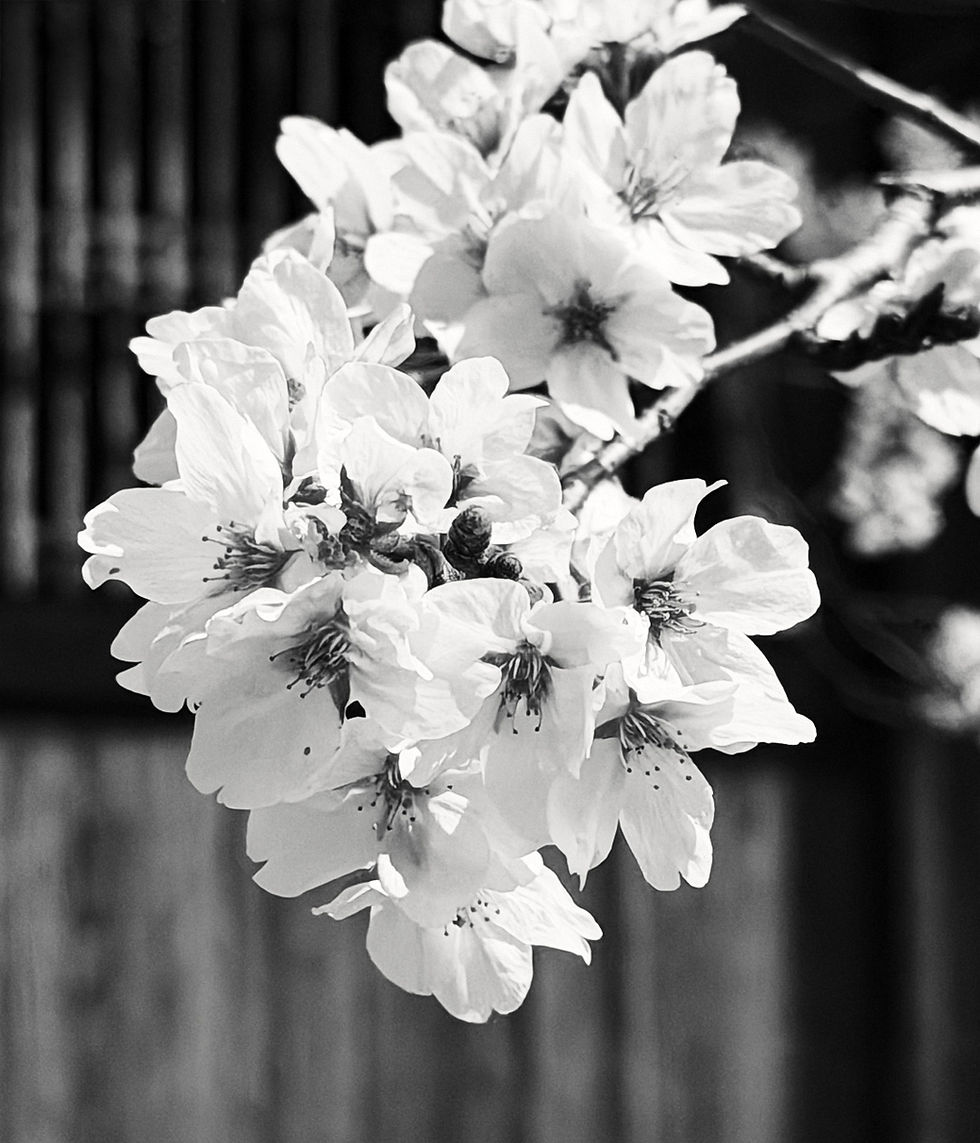
© O. Robert
Bashō, the most renowned of the haiku poets, often used sakura to explore themes of impermanence and the passage of time. One of his most famous haiku reads:
"Cherry blossoms
A petal falls on the temple bell
Softly, softly"
This haiku beautifully captures the quiet, almost sacred moment of a petal falling, linking the natural world with the spiritual.

© O. Robert
Buson, who was also a painter, brought a visual sensibility to his haiku. His poems often evoke vivid images, such as:
"Cherry blossoms in the morning
Cherry blossoms in the evening
How quickly they fall!"
This haiku emphasizes the rapid passage of time, a central theme in both sakura and Japanese aesthetics.

© O. Robert
Issa, known for his compassionate and sometimes humorous haiku, also wrote about cherry blossoms. One of his poems reads:
"Don’t worry, sparrows
Here, too, in this world
Cherry blossoms bloom"
This haiku reflects Issa’s belief in the beauty and resilience of life, even in the face of hardship.

Modern Poetry
Sakura continues to inspire modern Japanese poets, who explore its themes in new and innovative ways. Poets like Takahama Kyoshi (1874-1959) and Mizuhara Shūōshi (1892-1981) have written about cherry blossoms, often linking them to personal or historical events.
Kyoshi, a disciple of Bashō, wrote haiku that reflect a deep connection to nature. One of his sakura-themed haiku reads:
"Cherry blossoms
The old castle moat
A single petal floats"
This haiku captures the contrast between the enduring structure of the castle and the fleeting beauty of the blossoms, a theme that resonates with the Japanese concept of mono no aware.

© O. Robert
To learn more about the relation between haiku and minimalist photography, you can read my dedicated article here.
Sakura in Literature
Sakura is not only a subject of poetry but also appears in prose, essays, and even novels. In Natsume Sōseki’s (1867-1916) novel Kokoro, sakura serves as a backdrop for the story’s exploration of guilt, redemption, and the passage of time. The protagonist’s reflections on the cherry blossoms mirror his own internal struggles, reinforcing the idea that nature is a mirror of human emotions.
Another notable work is Yasunari Kawabata’s (1899-1972) The Old Capital, where sakura appears as a symbol of beauty and nostalgia. Kawabata’s delicate prose captures the quiet elegance of the blossoms, using them to evoke the ephemeral nature of youth and love.

© O. Robert
Famous Places to Enjoy Sakura in Japan
Japan is home to countless hanami spots, each offering a unique experience. Many of Japan’s most famous castles are surrounded by cherry trees, enhancing their beauty and historical significance. Here are a few notable examples (Unless otherwise noted, the photographs do not depict the examples described).
1. Ueno Park, Tokyo
Ueno Park is Tokyo’s most popular hanami spot, with over 1.000 cherry trees lining its paths. The park becomes a sea of pink in late March to early April, attracting millions of visitors. The atmosphere is festive, with food stalls, street performers, and lantern-lit evenings.

© O. Robert
2. Philosopher’s Path, Kyoto
The Philosopher’s Path, named after the philosopher Nishida Kitarō (1870-1945), is a serene canal-side walkway lined with hundreds of cherry trees. In spring, the path becomes a tunnel of pink, reflecting beautifully in the water. It is a favorite spot for photographers and tourists seeking a lively hanami experience. Definitely a spot I wouldn't recommend for minimalist photography...
3. Mount Yoshino, Nara
Mount Yoshino is one of Japan’s most historic hanami spots, with records of cherry blossom viewing dating back to the 8th century. The mountain is covered in over 30.000 cherry trees, which bloom in succession from the base to the summit. The view from the top is breathtaking, offering a panoramic vista of pink and white.

4. Himeji Castle, Hyogo
Himeji Castle, a UNESCO World Heritage site and one of Japan’s most breathtaking architectural masterpieces, is a sight to behold in any season. Yet, it is during sakura season that the castle truly transcends into something magical, as if lifted straight from the brushstrokes of a living ukiyo-e print.
Known for its elegant, white-plastered walls that resemble a heron in flight, the castle takes on an even more ethereal quality when framed by the soft pink hues of cherry blossoms. The castle’s expansive grounds are home to more than 1.000 cherry trees, primarily of the Somei-Yoshino, along with Shidarezakura and Yaezakura trees.

Himeji Castle © O. Robert
Himeji Castle’s vast grounds provide ample space for visitors to spread out and enjoy the blossoms in relative tranquility during hanami. Families, couples, and solo travelers alike can be seen picnicking under the cherry trees, sipping tea, and soaking in the atmosphere. Read my article on Himeji Castle here.
5. Osaka Castle, Osaka
Osaka Castle Park is one of Japan’s most iconic and vibrant destinations for experiencing the magic of sakura season. With over 4.000 cherry trees dotting its expansive grounds, the park transforms into a sea of pink and white blossoms each spring. It also draws visitors from around the world to partake in the time-honored tradition of hanami.

Osaka Castle © O. Robert
The variety of sakura here is as impressive as it is diverse, featuring not only the classic Somei-Yoshino but also Yaezakura. During sakura season, Osaka Castle Park becomes a hub of energy and celebration, embodying the lively spirit of Osaka itself. The park’s open spaces and scenic pathways are filled with picnickers, families, and friends gathering under the cherry trees to enjoy food, drinks, and each other’s company. Read my article on Osaka Castle here.

6. Hikone Castle, Saga
Hikone Castle's sakura season often peaks slightly later than Kyoto or Tokyo (typically early to mid-April), thanks to its location near Lake Biwa, which moderates the climate. The surroundings, moats, and Genkyūen Garden are home of over 1.000 cherry trees.
This makes it an ideal destination for travelers who miss the earlier blooms elsewhere. The Shidarezakura in Genkyūen are particularly famous for their dramatic, cascading branches, which create a romantic, almost surreal atmosphere. Read my article on Hikone Castle here.

Himeji Castle Yagura © O. Robert
7. Hirosaki Castle, Aomori
The castle’s expansive grounds, which span over 400.000 square meters, are home to more than 2.600 cherry trees, including Somei-Yoshino, Shidarezakura, and Yaezakura. Unlike many other sakura spots in Japan, Hirosaki’s cherry blossoms bloom later in the season, typically from late April to early May, due to its cooler climate.
This delayed blooming period offers travelers a rare opportunity to experience hanami long after the sakura in Kyoto or Tokyo have faded. The trees are planted in such a way that they create a pink canopy over the castle’s moats, pathways, and bridges, transforming the entire area into a fairy-tale-like landscape.

Ninnaji Temple, Kyoto © O. Robert
8. Ninnaji Temple, Kyoto
Ninnaji Temple (formerly Omuro Imperial Palace) is renowned for its unique collection of over 200 Omurozakura cherry trees (photo above). Their blooming period begins roughly a week to ten days later than that of the Somei-Yoshino cherry blossoms, effectively heralding the close of spring in Kyoto. While their origins trace back to the Heian period, the current trees were planted in the early Edo period. In recognition of their beauty, the area was designated a Place of Scenic Beauty in 1924.
9. The Oldest Sakura
This list is by no means exhaustive (if it were, it could never truly be complete!). Each person will form their own opinion about the most symbolic locations, depending on their personal quest or aesthetic criteria. That said, I would be remiss if I didn’t mention the oldest sakura I’ve had the privilege of photographing or visiting.

Matabeizakura © O. Robert
These centuries-old specimens are often tucked away in the countryside. Reaching them without a vehicle is difficult, and their blooming periods vary wildly from year to year. More often than not, it’s a matter of luck. Yet, without a doubt, these are by far the most spectacular sakura you’ll ever encounter.
Far from the tourist-filled temples and shrines of major cities, these giants have grown under natural conditions in unique environments. Many are scattered across the Japanese peninsula, but the most remarkable ones have inevitably gained fame through social media.

Every year, visitors flock in droves to capture the floral splendor and sheer grandeur of these cherry trees. As a result, these sites (Underdeveloped for tourism) have become a nightmare for local residents, who must find creative ways to accommodate the crowds. The obvious lack of parking leads to endless lines of cars, and tourists sometimes wait for hours just to access the site.

Matabeizakura © O. Robert
But no matter the challenges, the reward is worth the wait. Among my personal favorites are: Matabeizakura (~300 years old, Nara Prefecture), Saikoji Sakura (~400 years old, Nara Prefecture), Neo no usuzumizakura (~1.500 years old, Gifu Prefecture), Mizumezakura (Shizuoka Prefecture), and Ayashizato Wakamiya no Shidarezakura (Nagano Prefecture).

Saikoji Sakura © O. Robert
10. Osaka Mint Museum: A Last Resort for Latecomers
Missed the peak sakura bloom on your late-season trip? Don’t panic. You can still catch a glimpse at the Osaka Mint Museum, which opens its gates to the public for free every mid-April. Just be sure to register online and select a time slot in advance.
As a penance for your tardiness, prepare for an unrelenting crowd experience. You’ll be herded down a narrow, one-way path (no turning back!) while admiring the late-blooming cherries (140 varieties, 330 trees, photo below). Add to that the guards patrolling against the crowd, shouting through megaphones about everything you’re not allowed to do (and there are many!). An atmosphere as chaotic as it is paradoxical, given the usual serenity of sakura viewing. It’s exhausting, disorienting, and far from peaceful. Yet somehow, still worth the visit...

Osaka Mint Museum Sakura © O. Robert
The Three Great Sakura of Japan
Japan is undeniably a nation obsessed with ranking anything that exists in more than two places. I’ve lost count of the endless lists of the 'best', 'most beautiful', 'oldest', 'most famous', and 'rarest' things I’ve written articles about. Checking off these spots over time is practically a tourist tradition. Though, in reality, it’s mostly a boon for local businesses. And of course, sakura are no exception to the rule...
Japan’s Three Great Sakura (日本三大桜) are considered as living monuments, each with centuries of history, cultural significance, and breathtaking beauty. Designated as Natural Monuments of Japan in 1922, these ancient cherry trees draw visitors from around the world, offering a glimpse into the country’s deep reverence for nature and tradition.

© O. Robert
1. Miharu Takizakura (三春滝桜) in Fukushima Prefecture
Age: Over 1.000 years old (estimated to have been planted in the Heian period).
Type: Prunus pendula (weeping cherry, shidarezakura).
Height: 12 meters.
Canopy Spread: 20 meters wide, with branches cascading like a "waterfall of blossoms", hence its name: Takizakura means "waterfall cherry".
Blooming Season: Mid to late April, later than most sakura due to Fukushima’s cooler climate.
2. Neo no Usuzumizakura (淡墨桜) in Gifu Prefecture
Age: Estimated at 1.500 years old (possibly planted during the Asuka period by Emperor Keitai).
Type: Prunus jamasakura (wild mountain cherry).
Height: 16 meters.
Unique Feature: Its blossoms are pale pink to almost white, with a subtle grayish tint, resembling diluted ink (usuzumi), which gives the tree its name.
Blooming Season: Early to mid-April.
3. Jindaizakura (神代桜) in Yamanashi Prefecture
Age: Over 2.000 years old, possibly the oldest cherry tree in Japan (planted in the Jōmon or Yayoi period, before written records).
Type: Prunus jamasakura (wild mountain cherry).
Height: 10 meters, though its sprawling branches create a vast, umbrella-like canopy. The trunk Circumference is 13.5 meters. So massive that it appears hollow inside, with space for people to stand within its trunk.
Blooming Season: Early April.

Sakura and Photography
For artists and poets, sakura is a muse that inspires reflection on life’s brief moments. In a world that often feels rushed and disconnected, sakura reminds us to pause, to appreciate the present, and to find beauty in the ephemeral. As a photographer, I am continually drawn to the challenge of capturing this short-lived beauty, knowing that each image is a celebration of a tradition that has shaped Japanese culture for centuries.
For artists and photographers alike, sakura presents both a challenge and an opportunity. The blossoms’ short lifespan means that timing is everything. A single rainstorm can strip the trees bare, so photographers must be ready to capture the peak bloom or the various blooming stages mentioned earlier, depending on one’s personal focus.

© O. Robert
Time, Colors, and Tips
Naturally, for the vast majority of people, the most captivating period is Mankai (full bloom), which usually occurs about a week after the first blossoms appear. In Tokyo, this is typically late March to early April. In Kyoto, it is slightly later.
However, black and white photography does not necessarily follow the same expectations as color photography when it comes to capturing sakura. It has its own unique demands and approach, centered on emphasizing contrasts and textures. As a result, our creative pursuit often exists on the margins of what mainstream media promotes, far removed from conventional clichés.
Below are some personal insights drawn from my photographic experiences across many springs.

© O. Robert
From Kaika to Hashibu-zaki
The full bloom period is undeniably a feast for the eyes, a singular botanical spectacle and a cherished Japanese tradition that deserves to be celebrated.
That said, my experiences over the past few years have led me to reconsider full bloom as the only ideal moment for photography. In fact, on many occasions, I have found myself before sakura that had not yet reached their peak. The scene in these moments is often far more delicate and poetic. It opens up greater freedom in compositions, emphasizing transparency or the lone blossoms clinging to the tips of branches.

Shidarezakura at Taizo-in Temple, Kyoto © O. Robert
From Sakura Fubuki to Hana no Nagori
By the same logic, exploring the end of the blooming season is also a deeply rewarding endeavor. It offers a unique opportunity to highlight the delicate carpets of petals scattered across gravel gardens or floating on the surface of a canal. This stage of the sakura season is particularly cherished in Japan, so much so that it is far more frequently referenced in poetry, literature, and painting than even the Mankai period.
Based on the species and botanical details provided earlier, you can more precisely target the sakura spots that interest you most. That said, as mentioned earlier, many sakura varieties bloom at different times. I highly recommend checking the blooming updates on the websites of these locations (temples, shrines, cities, etc.) or their Instagram accounts to avoid missing a prime opportunity.

© O. Robert
From Somei-Yoshino to Shidarezakura
Personally, as someone deeply fascinated by Shidarezakura above all other species, I’ve noted over the years that their ideal photography window extends far beyond the brief bloom of Somei-Yoshino (photo above). From the most spectacular specimens tucked away in the countryside (list above) to the magnificent examples that grace Kyoto’s temples with pride, these weeping cherry trees possess a rare and unparalleled elegance. For some years now, I have chosen to focus exclusively on this species (and its various cultivars).

It is therefore no surprise that Shidarezakura are also the most frequently depicted species in Japanese and Chinese visual art since time immemorial. In Japan, countless woodblock prints (ukiyo-e) feature these graceful weeping cherries in their compositions. Similarly, in China, traditional ink paintings abundantly reference this species to evoke springtime scenes. Alongside weeping willows, Shidarezakura have become an emblem of traditional ink paintings, symbolizing the poetic essence of the season.

© O. Robert
Overcast Skies, Sunny Skies
For my regular readers and those familiar with my work, my fondness for mist, cloudy skies, and even rainy days is no secret. However, sakura season is an exception. For one, this season is typically accompanied by bright, sunny days and clear blue skies. Additionally, an overcast sky doesn’t provide enough contrast to distinguish the white blossoms from the clouds, especially since the sky often needs to be included in compositions.
A vivid blue sky, on the other hand, becomes an intriguing element to emphasize in printing, all while preserving the immaculate whiteness of the blooming sakura.
Similarly, the harsh light cast on the ground, trees, or other elements creates striking opportunities to highlight the delicate blossoms. Rocks, lanterns, and stone statues reveal their textures and harmonize beautifully with the softness of the cherry trees.

© O. Robert
Pink, Black, and White
Not being a fan of the color pink (whether light or dark), I find neither sufficient elegance nor poetry in late-blooming sakura, with the obvious exception of Omurozakura, which I mentioned earlier. As a result, my focus now lies exclusively on sites featuring pale blossoms. Somei-Yoshino is a reliable choice, but other species effortlessly rival it in elegance and poetic charm.
Historically, the grounds of Sengoku-era castles were often planted with Somei-Yoshino. Shidarezakura, on the other hand, are typically found as singular, striking subjects, positioned at entrances, along pathways, or in strategic locations like gardens. Consequently, castles such as Himeji, Osaka, Hikone, and Hirosaki become prime locations for monochrome photography. And that’s without even considering the added value of their architectural masterpieces, which elevate every composition. Read my article on the Japanese castles here.

Many temples also serve as ideal locations for capturing the intimate beauty of cherry trees, which are among their most treasured seasonal features. I would highlight the stunning weeping cherry of Kōdaiji Temple (Kyoto) and the one at Hōnmanji Temple (Kyoto). Unfortunately, the high visitor traffic during peak bloom and the limited space for composition pose technical challenges. It’s essential to account for these factors and, if possible, plan multiple visits at different times to fully capture the essence of these places.
More recently, I had the honor of being invited to photograph Ninnaji Temple (Kyoto) during the full bloom of its Omurozakura, a breathtaking spectacle (photo below). The botanical richness of this site is unparalleled, as these 200 cherry trees are unique in the world. I highly recommend visiting Ninnaji, both for its cultural significance and its photographic potential.
However, patience is key, as the temple attracts large crowds during the Omuro Festival (held when these cherries bloom). Unless you have the privilege of an invitation and early access (which I greatly appreciated), you should plan for at least 1.5 to 2 hours just to explore the cherry tree garden.

Omurozakura at NinnajiTemple, Kyoto © O. Robert
The Final Word
In Japan, the sakura time is more than a change of seasons. It is a pause, a shared breath where past, present, and future seem to meet beneath the branches. Poets have written of it, painters have brushed its likeness onto silk, and today, photographers still chase its light, each in their own way. Sakura does not belong to any single era or art form; it is a thread connecting those who stop to notice it, wherever and whenever they may be.
Every year, I find myself returning to the same places, Kyoto’s temples, the castles of Osaka and Himeji, or beautiful gardens not in search of repetition, but revelation. The trees are the same, yet the light shifts, the air feels different, and what I bring to the scene changes too. Photography, here, is less about preserving what is seen and more about discovering what endures beyond the viewfinder.
There is a sakura season everywhere cherry blossoms bloom but there is only one Japan.
Nowhere else do the trees hold the weight of centuries of poetry, the quiet presence of those who came before, or the unspoken understanding that these blossoms are more than flowers.
Nowhere else do cities collectively still themselves to welcome spring in this way, where the rustle of petals and the click of cameras become part of the same story. The sakura you will see here may look the same as those in other places but in Japan, they belong to something greater.
So come. Stand beneath the branches in Kyoto’s hidden gardens or beside the moat of Himeji Castle where petals fall like pages from an old tale. Walk the Philosopher’s Path at first light when the blossoms glow as if lit from within. Let this season show you that some things are not just meant to be seen. They are meant to be experienced here, where the trees have always been part of the soul of the land.


