


Japan: Aoi Matsuri, Kyoto’s Heian-Period Grand Procession

Updated: Sep 25
The Aoi Matsuri (葵祭) is one of Kyoto’s most celebrated and historically rich events. Held annually on May 15, it stands alongside the Gion Matsuri and Jidai Matsuri as one of the city’s three great festivals. Its origins trace back to the 6th or 7th century, making it one of Japan’s oldest festivals, deeply rooted in the traditions of the imperial court and the Shinto faith.

Saio-Dai © O. Robert
The Aoi Matsuri (葵祭) is a living testament to Kyoto’s cultural and spiritual heritage. For over 1.400 years, the festival has been a symbol of resilience, social upheavals, and periods of suspension. Its revival after World War II and its continued popularity today reflect the enduring importance of tradition in Japanese society.
The festival focuses on harmony between people, nature, and the divine. It resonates deeply in a modern world marked by division and haste. The meticulous preservation of Heian-period customs, from the costumes to the rituals, allows participants and spectators alike to step back in time and experience the elegance of imperial Kyoto.
From a photographic perspective, the Aoi Matsuri (alongside the Jidai Matsuri and Gion Matsuri) is a major event that any photographer visiting Kyoto should experience. The quality of the costumes, the staging, and the cultural power they exude make them perfect subjects. However, you’ll need patience and must accept compromises due to the crowds that gather along the routes. By isolating the subjects from the backgrounds, it’s a unique opportunity to capture cinematic portraits.

At Kamigamo Shrine © O. Robert
The festival’s name, "Aoi", comes from the heart-shaped leaves used to decorate everything from shrine buildings, Torii and imperial carriages to the clothing and headwear of participants (photo above). These leaves are considered sacred and symbolized the divine crests (Shinmon) of the Kamo Shrines.
A Little Bit of Botany...
The aoi plant associated with the Aoi Matsuri is not the hollyhock (Alcea rosea) as often suggested, which is not native to Japan, but rather the wild ginger (Asarum), specifically Asarum caulescens or Asarum sieboldii. This plant belongs to the Aristolochiaceae family and is native to Japan.
Aoi is known for its heart-shaped, glossy green leaves, which grow in pairs. It is commonly known as Futaba aoi (二葉葵, "two-leaved aoi") or Kamo aoi (賀茂葵), referencing its connection to the Kamo Shrines in Kyoto. The leaf also appears in the crest of the Tokugawa family (Edo Period), grouped in threes and known as Mitsuba aoi ("three-leaved aoi").
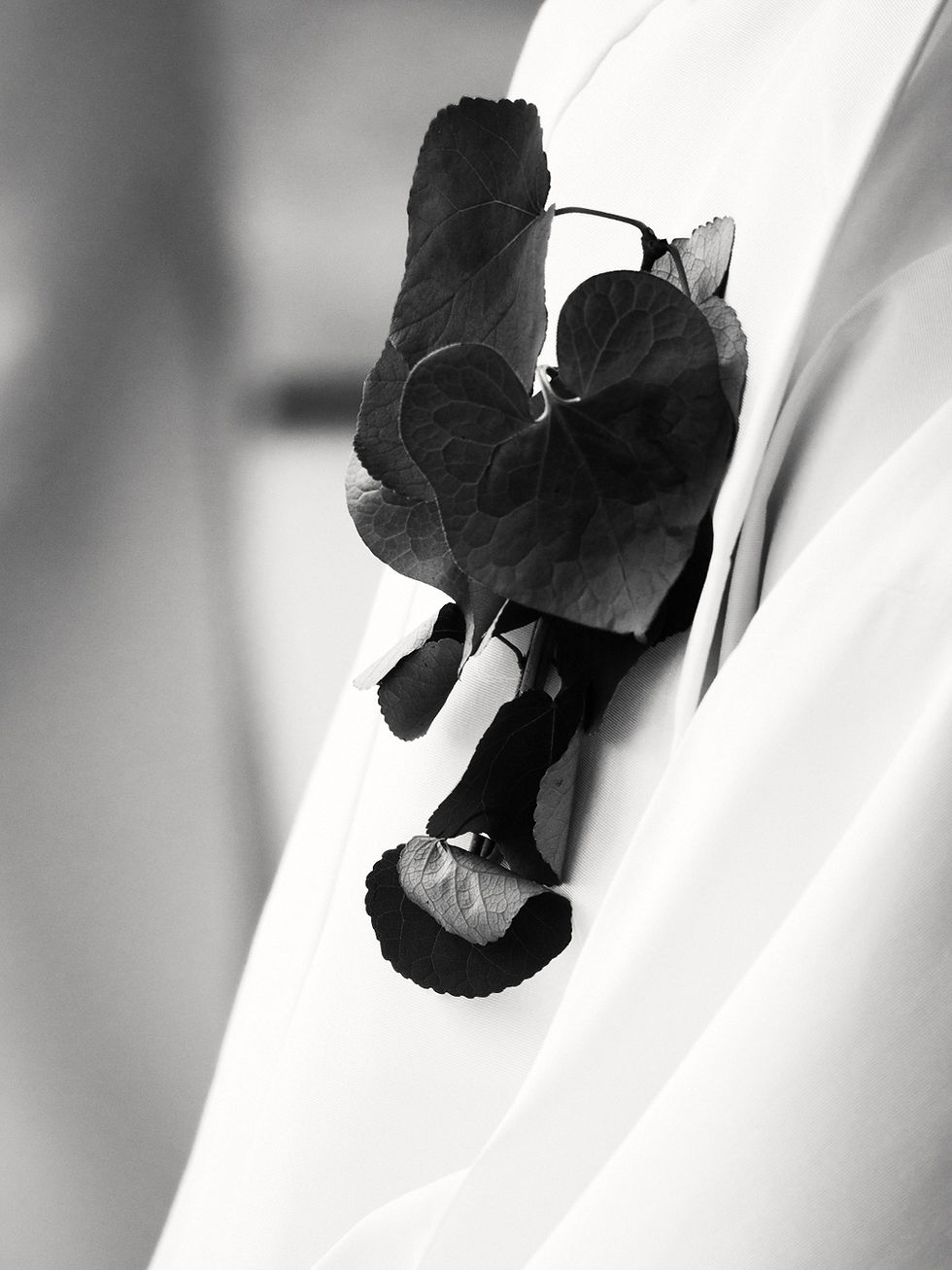
Aoi Leaves © O. Robert
The leaves are evergreen in mild climates and have a leathery texture. It grows as a low, spreading ground cover, typically reaching a height of 10-30 cm (4-12 inches). Aoi spreads via underground rhizomes, which have a ginger-like aroma, earning it the common name "wild ginger". No wonder that Asarum has also been used in traditional medicine in some East Asian cultures for centuries.
The flowers are small, bell-shaped, and often hidden beneath the foliage. They are typically dark purple or brownish and have a unique, sometimes spicy fragrance. If you observe the emblem of Shimogamo Shrine, featuring two aoi leaves, you may notice a small flower depicted between them, which could easily be mistaken for a fruit.
But I’m sure you didn’t come to this article just to improve your botanical knowledge, did you? So, even though this subject fascinates me, let’s leave botany aside and dive into the Aoi Matsuri.

Origins and Evolution
The Aoi Matsuri began as a ritual to appease the kami*, deities of the Kamo Shrines, Shimogamo and Kamigamo, who were believed to have caused natural disasters such as storms, floods, and plagues. According to historical records, including the Shoku Nihongi (続日本紀), Emperor Kinmei (欽明天皇, reigned 539-571) or Emperor Monmu (文武天皇, reigned 697-707) ordered rituals to calm the angry kami after a series of calamities struck the region.

Mikage Matsuri, Shimogamo Shrine © O. Robert
* What are the kami?
In Shinto, the traditional religion of Japan, kami are the sacred spirits or divine beings believed to inhabit the natural world. They are not gods in the Western sense but rather the essence of life, purity, and harmony found in nature, ancestors, and even extraordinary phenomena. Kami are present in mountains, rivers, trees, and storms, as well as in shrines, where they are honored through rituals and offerings.
The concept of kami reflects a deep respect for the interconnectedness of all things, embodying the Shinto belief in the sacredness of the natural and ancestral world. To learn more about their specificities, you can read my dedicated article here.

Mikage Matsuri, Shimogamo Shrine © O. Robert
By the 8th century, when Kyoto became the imperial capital, Emperor Kanmu formalized the Aoi Matsuri as an annual imperial event.
During the Heian Period (794-1185), the festival reached its peak of grandeur during this era. The word "Matsuri" was so closely associated with the Aoi Matsuri that it was often used exclusively to refer to this festival, almost as if no other festival existed in Kyoto at the time. In other words, "Matsuri" became synonymous with the Aoi Matsuri itself.

During the Kamakura and Muromachi Periods (1185-1573), the festival’s prominence waned as political power shifted from the imperial court to the military shogunates. By the time Japan entered the Sengoku Period (late 15th to early 17th century), the Aoi Matsuri procession was discontinued due to the chaos of civil war.
During the Edo Period (1603-1868), the festival was revived during the Genroku Era (1688-1704), reflecting a renewed interest in traditional culture under the Tokugawa shogunate. However, its observance was intermittent, depending on the political and social stability of the time.

At Imperial Palace © O. Robert
During the Meiji Period (1868-1912), as we all know, the capital moved from Kyoto to Tokyo (1869). The festival procession was halted once again, as the imperial court’s departure reduced Kyoto’s central role in national ceremonies.
During the Modern Era (20th Century-Present), the Aoi Matsuri was revived. The Saio-Dai tradition was re-established in 1956. Today, it stands as one of Kyoto’s most cherished festivals, a living link to Japan’s imperial past and a celebration of its cultural resilience.

Join us for a Photo Tour where you’ll discover timeless beauty, immerse yourself in local culture, and uncover hidden photographic gems. We explore Japan’s contrasts, tradition and modernity, serenity and energy, nature and urban pulse… If these dualities inspire you, see the program here.
The Aoi Matsuri consists of several parts like the grand procession, called Rotō no Gi (路頭の儀), the Mikage Matsuri (御蔭祭), and different rites held at the shrines, called Shato no Gi (社頭の儀). The procession is the festival’s centerpiece, featuring over 600 participants dressed in the elegant aristocratic attire of the Heian Period. However, the Mikage Matsuri which is a prelude to the Aoi Matsuri itself, is a crucial spiritual part of this major event, and is held on May 12 (see below).

Gissha Cart, Imperial Palace © O. Robert
The Grand Procession
The Rotō no Gi parade (路頭の儀) begins at the Kyoto Imperial Palace, passing through the city before arriving at Shimogamo Shrine and finally Kamigamo Shrine. The route is lined with spectators, and paid seating is available at the Imperial Palace and Kamigamo Shrine for those seeking a more immersive experience.

Mikage Matsuri, Shimogamo Shrine © O. Robert
Among the famous historical figures, symbols, and performances depicted during this festival, we notably find:
The Saio-Dai
Historically, the Saio-Dai (斎王代) was a young female member of the imperial family who served as the high priestess of the Kamo Shrines. Today, an unmarried woman with strong ties to Kyoto is chosen annually to fulfil this role (photo below).
The selection is made by the Aoi Matsuri Procession Preservation Society, based on recommendations from individuals involved in the festival, ensuring the candidate is accustomed to wearing kimono and understands traditional Kyoto customs. The Saio-Dai is typically announced in early April each year.

Saio-Dai 斎王代 © O. Robert
Before the festival, she undergoes rigorous purification rituals, including a ceremonial bath in the Mitarashi River at Shimogamo Shrine in early May, before donning a 30-kg, 12-layered silk kimono for the festival. The Saio-Dai acts as a representative of the emperor in the context of the festival, maintaining ritual purity and participating in ceremonies on his behalf.
There is no public cost for the chosen woman herself, as the role is considered a prestigious honor. All expenses related to her participation, including the elaborate 12-layered silk kimono, are covered by the organizing bodies.
However, being Saio-Dai is not without consequences, particularly financial, for the selected woman’s family. The honor of holding this prestigious title is widely shared with friends and neighbors, and it is customary to host several receptions and offer food to the community. These indirect expenses can sometimes be a heavy burden for modest families. Yet, no official financial support is provided by the shrines or the Aoi Matsuri Procession Preservation Society.

The Imperial Messenger and Followers
The Imperial Messenger, known as the Chokushi, is one of the most distinguished figures in the Aoi Matsuri procession. Dressed in the formal robes of a Heian-period court official, he leads the grand parade, embodying the authority and dignity of the imperial court. His role is both symbolic and practical. He represents the emperor’s presence in the festival, ensuring that the procession adheres to the traditions and protocols established over a thousand years ago.

At Imperial Palace © O. Robert
Following him are two ornate oxcarts, each pulled by oxen and decorated with artificial wisteria flowers, a detail that adds a touch of seasonal beauty to the scene. These carts, called Gissha (牛車), are replicas of the vehicles used by aristocrats during the Heian Period, and their slow, deliberate movement through the streets of Kyoto evokes the majesty of ancient imperial processions.
Behind the oxcarts, 4 cows and 36 horses, each adorned with hollyhock leaves, follow in an orderly fashion. They are accompanied by over 600 participants, all dressed in the elaborate and colorful costumes of Heian-era nobles, officials, and attendants. The sheer scale of the procession, with its meticulous attention to historical detail, offers a vivid glimpse into the splendor of Kyoto’s imperial past.

At Shimogamo Shrine © O. Robert
Horse Races and Mounted Archery
The Aoi Matsuri is not only a celebration of elegance and tradition but also a display of skill and precision. Among its most exciting elements are the traditional horse races, known as Kurabe-uma (競馬), and the demonstrations of mounted archery, or Yabusame (流鏑馬).
These events add a dynamic and energetic contrast to the otherwise stately and ceremonial atmosphere of the procession. In the Kurabe-uma, riders in Heian-period attire race their horses along a designated course, showcasing both their equestrian skills and the speed of their steeds. The Kurabe-uma takes place at the end of the festival, at Kamigamo Shrine, after the main rituals, around 6:00 PM.

The Yabusame, on the other hand, is a test of archery prowess. Archers on horseback gallop along a track, drawing their bows and firing arrows at targets with remarkable accuracy. These demonstrations are deeply rooted in the festival’s origins as a ritual to appease the deities of the Kamo Shrines. The Yabusame takes place in the days before the parade, usually around May 1 or 2.
At both Shimogamo and Kamigamo Shrines, the festival unfolds through a series of deeply symbolic ceremonies that bring the sacred traditions of the Kamo Shrines to life. To learn more about Shintoism, you can explore all my dedicated articles here.

At Kamigamo Shrine © O. Robert
Gagaku and Bugaku
These rituals include performances of Gagaku (雅楽), the ancient imperial court music, whose haunting melodies and slow, deliberate rhythms fill the air with a sense of timelessness. Accompanying the music are sacred dances, or Bugaku (舞楽), executed with precise, graceful movements that tell stories of divine favor and human devotion. These performances are designed to honor the kami and ensure their continued blessings.
Central to these shrine rituals are the formal offerings presented to the deities. These offerings (food, sake, and other symbolic items) are meticulously prepared and presented with the utmost respect, reflecting the deep connection between the people of Kyoto and their spiritual guardians.

At Imperial Palace © O. Robert
The Mikage Matsuri
The Mikage Matsuri (御蔭祭) is a solemn and significant prelude to the Aoi Matsuri, held annually on May 12 at Shimogamo Shrine. It is definitely one of my most favorite moments of the Aoi Matsuri period. This ceremony serves as a ritual to welcome the kami of the Kamo Shrines to the festival, ensuring their presence and blessings for the upcoming event. The Mikage Matsuri is deeply rooted in Shinto tradition and marks the beginning of the Aoi festival’s spiritual preparations, setting the stage for the grand procession and shrine rites that follow on May 15.
Mikage Matsuri is especially well known for maintaining an ancient form of worship in which the divine spirit is transferred onto a sacred horse and ceremonially brought to the main shrine (photo below).
At the foot of Mount Hiei lies Mikageyama (御蔭山), a mountain where Mikage Shrine is located, and the sacred place of the Aramitama (荒御魂), the powerful and active spirit of the deity worshipped at Shimogamo Shrine. It is believed that on May 12, a new divine spirit is born at Mikage Shrine (hence the name of this festival).

Mikage Shrine Forest © O. Robert
In the morning, at the Maidono Hall (舞殿) of Shimogamo Shrine, the Kanpai no Gi (神拜の儀) ritual and the Juge Shinji (樹下神事) ceremony are performed. After this, a formal procession of Shinto priests and parishioners, known as the Gyosho, departs through the Romon Gate and proceeds toward Mikageyama.
When the procession arrives at Mikage Shrine on Mikageyama, a sacred rite is conducted at noon to transfer the newly born divine spirit. They perform a series of rituals and invite the kami’s spirit to accompany them back to Shimogamo Shrine.
The divine spirit then descends the mountain together with the procession. Afterwards, the procession reaches Kamo Hani Shrine, where the Rojisai* (路次祭) ritual is performed and a traditional bugaku court dance called Genjoraku (還城楽) is dedicated.
* The Rojisai is one of the sequential Shinto rituals that ensure the deity’s presence and blessings for the upcoming Aoi Matsuri. It involves welcoming the newly born Aramitama (荒御魂, the wild and brave spirit of the deity) and preparing for its union with the Nigimitama (和御魂, the harmonious spirit) already enshrined at Shimogamo Shrine.

In the northern area of Shimogamo Hondori (the main street leading to the shrine), the divine spirit is transferred onto a sacred horse (photo below). Then, the procession proceeds south along Shimogamo Hondori toward Shimogamo Shrine. On the way to the sanctuary, sacred songs praising the deity are performed together with ritual dance before the sacred horse in the Tadasu no Mori forest. It is called the Kirishiba Shinji ritual (切芝神事).
Finally, after proceeding to the main sanctuary, the newly welcomed divine spirit becomes united with the divine spirit already enshrined at Shimogamo Shrine, and its sacred power is thereby strengthened.

Sacred Horse, Kamigamo Shrine © O. Robert
Mikage Matsuri is a festival I highly recommend seeing if you have the opportunity. The procession passes through many of the less touristy streets in the northern part of the city before entering the forest of Mikage Shrine. While there are many local visitors, it is entirely possible to photograph the procession at your leisure, without having to push through crowds of tourists. The setting is all the more striking within the forest of Mikage Shrine, where the procession stops for a long moment in front of a majestic Torii gate surrounded by towering trees.
Together, all these ceremonies offer a rare and profound glimpse into the Shinto practices that once formed the spiritual foundation of Kyoto’s imperial life, reminding participants and spectators alike of the enduring bond between the city, its people, and the divine.

At Shimogamo Shrine © O. Robert
Practical Information
For those wishing to attend, the Aoi Matsuri is held annually on May 15, unless it rains. In case of rain, the festival is postponed to the following day (May 16), and the decision is announced on May 14 at 6:00 PM.The procession starts at the Kyoto Imperial Palace (usually around 10:30 AM) and concludes at Kamigamo Shrine (around 7:00 PM), with the best viewing spots along the route or at the shrines themselves. Paid seating is available at the Imperial Palace and Kamigamo Shrine (which I recommend), but free viewing is also possible for those willing to arrive early.
Whether you are a history enthusiast, a lover of traditional culture, or simply someone seeking a unique and visually stunning experience, the Aoi Matsuri offers something unforgettable.

At Kamigamo Shrine © O. Robert
Aoi Matsuri and Photography
The festival’s grand procession, with its 600 participants in Heian-period costumes, the ornate oxcarts, and the stately Saio-Dai in her palanquin, offers endless opportunities for capturing the elegance and tradition of Kyoto’s imperial past.
The rituals at Shimogamo and Kamigamo Shrines, with their sacred dances, court music, and formal offerings, provide a deeper, more intimate look at the spiritual heart of the festival. Whether you focus on the vibrant colors of the costumes or the intricate details of the decorations, the Aoi Matsuri is a celebration of history and artistry that begs to be preserved through the lens. For the best shots, arrive early to secure a good position along the procession route or at the shrines, and be ready to capture the fleeting moments that make this festival a timeless spectacle.
However, we must not forget the historical and symbolic significance of the ceremonies that precede the Aoi Matsuri. The Saio-Dai purification ritual and the Mikage Matsuri are also unique opportunities to fully immerse oneself in the cultural importance of this festival.
Join us for a Photo Tour where you’ll discover timeless beauty, immerse yourself in local culture, and uncover hidden photographic gems. We explore Japan’s contrasts, tradition and modernity, serenity and energy, nature and urban pulse… If these dualities inspire you, see the program here.


